Ordering a Local Loop
A local loop, also known as a last-mile connection, is the external circuit that links your site, which is located outside a Megaport-enabled data center, to the designated Megaport-enabled data center.
This connection is often a dark fiber (DF)Dark fiber (DF) is essentially optical fiber infrastructure that is not in use. It is considered as capacity that has been laid in addition to that required at the initial time of service provisioning for expansion, growth, or resale. It is no longer considered dark once signals are traversing it (lit).
circuit that utilizes fiber outside the Megaport data center. The network diagram below illustrates the architecture and functionality of the local loop.
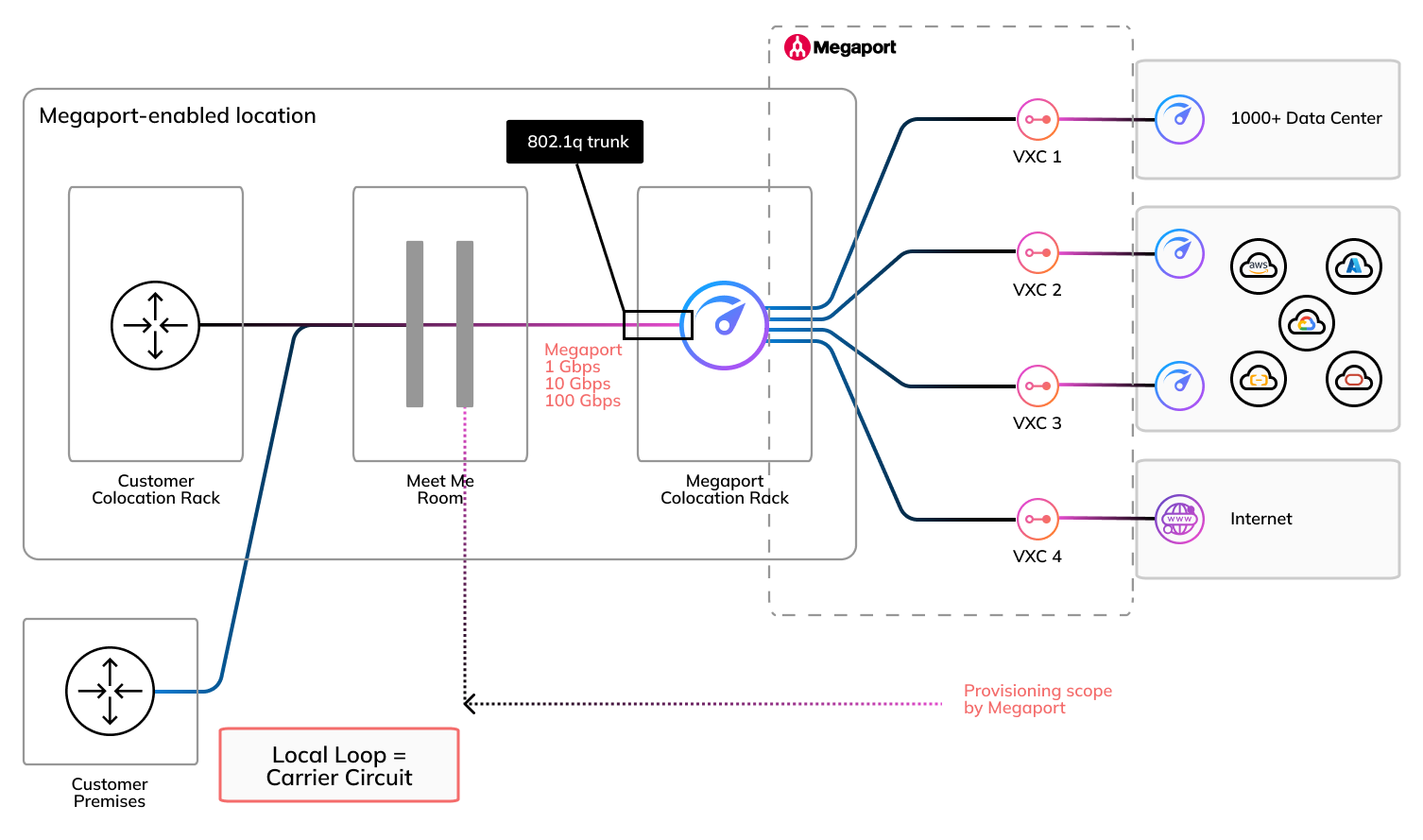
Local loop procurement and Megaport’s role
A local loop is typically procured and managed directly by you or a third-party carrier.
When a local loop is required to deliver Megaport services, Megaport provides proactive procurement support and works closely with both you and the Megaport-procured third-party carrier to streamline, speed up, and simplify the process.
However, since local loop provisioning remains a manual process, unlike Megaport’s generally automated ordering system, it will require additional time to complete.
Note
The Port will only be live after the local loop has been delivered. Therefore, when ordering a Port that includes a local loop, you should expect the Port’s availability to be delayed, as it depends on the local loop delivery timeline.
Local loop ordering workflow
Below is a step-by-step workflow describing how you can order a local loop through Megaport.
-
Contact your Megaport Account Manager to provide the required technical details for your local loop connection.
-
After the technical details are confirmed by you, the Megaport Account Manager, and the Megaport Solutions Architect, the request will be evaluated by the Megaport technical and support teams to determine feasibility, final delivery timeline, and total cost.
-
After Megaport determines that the proposed solution is feasible, the Megaport Account Manager will provide you with a Megaport Local Loop Service Order Form (MSO) for your review and acceptance of the pricing and terms and conditions.
-
After you sign the MSO, you create a Port in the Megaport Portal with minimum term of 24 months. For more information, see Creating a Port.
-
Megaport orders the local loop under a contract established between the carrier and Megaport.
-
Megaport will then place a Cross Connect order to establish the physical connection between your Port and the local loop demarcation point.
-
The Megaport Account Manager and the Megaport team will coordinate with you to bring the Port to the Live status by monitoring the Port’s light levels. If required, a troubleshooting process might be conducted involving the Megaport Account Manager, the Megaport technical team, you, and the carrier.
Summary of ordering a local loop
-
Early engagement – If you require a local loop to connect to a Megaport-enabled data center, we recommend engaging with your Megaport Account Manager as early as possible in the planning process.
-
Port order – After the local loop procurement details are finalized among you, your carrier contact, and Megaport, you can proceed to order a Port. The minimum term for a Port associated with a local loop is 24 months.
-
Local loop order placement – After the Port order is created and the Port is in the Configured status, Megaport will order the local loop service.